Static pool analysis compares groups of loans that originated during the same period and follows their performance at the same age. By aligning each vintage on months-on-book rather than calendar date, lenders can see whether underwriting, pricing, servicing, channel, or economic changes are improving or weakening portfolio performance.
What is static pool analysis?
A static pool, often called a vintage, is a fixed population created by a shared origination period or another controlled starting condition. No new accounts are added after the pool is defined. Analysts then measure outcomes such as delinquency, charge-offs, prepayments, recoveries, yield, or margin as each pool matures.
The method answers a question that an ordinary portfolio total cannot: how did comparable accounts perform at the same point in their lifecycle? A current portfolio loss rate can mix new and seasoned loans. A vintage view separates those ages so leadership can distinguish growth effects from real changes in credit performance.
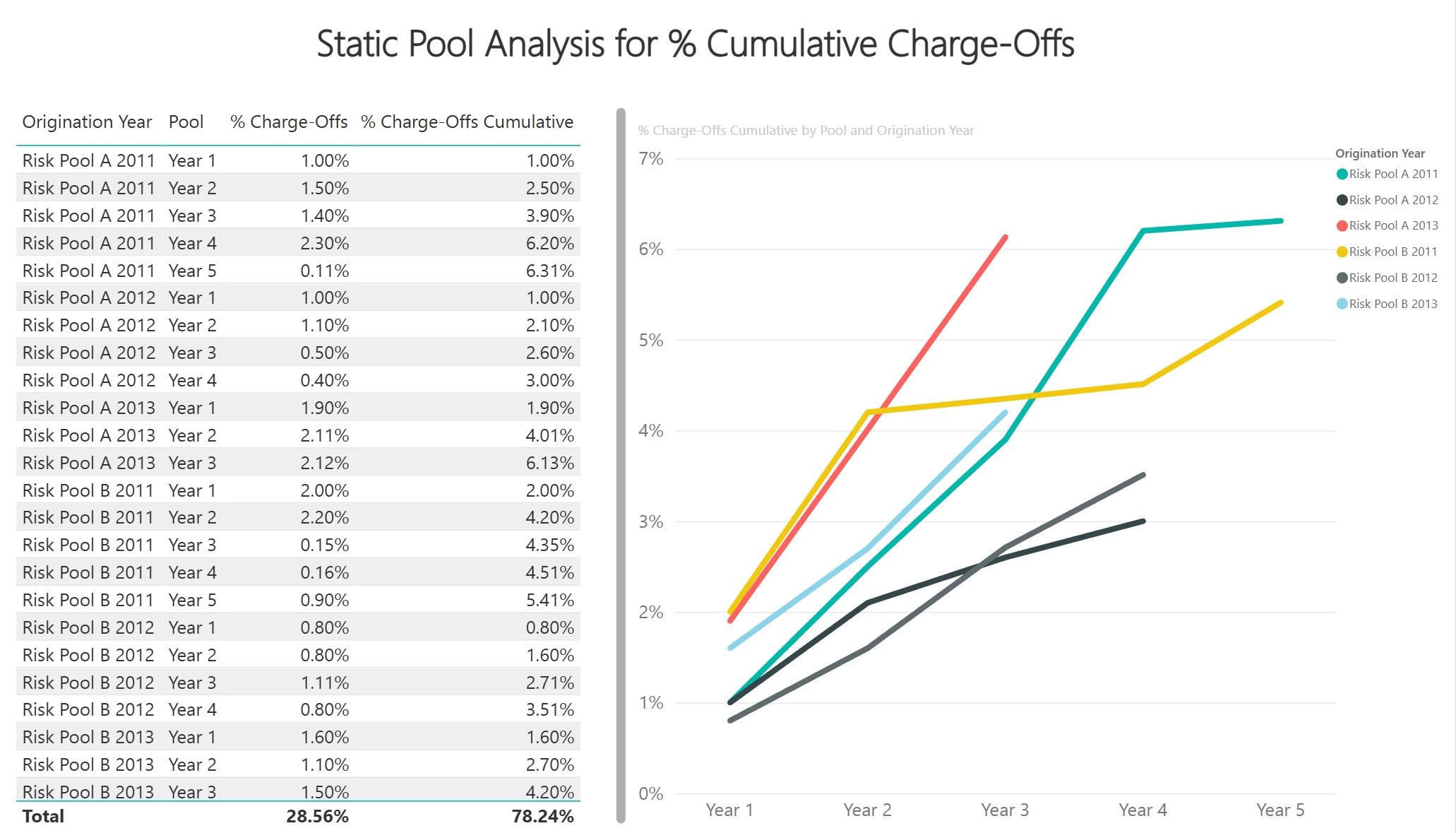
How a lending vintage comparison works
Assume a lender wants to compare loans originated in 2023, 2024, and 2025. Each group begins at month zero. The analyst calculates the same cumulative measure at month 3, month 6, month 12, and later ages. The resulting curves show whether newer originations are developing losses faster or slower than older vintages.
Illustrative cumulative charge-off rate by months on book
| Origination vintage | Month 3 | Month 6 | Month 12 |
|---|
| 2023 | 0.2% | 0.7% | 1.6% |
|---|
| 2024 | 0.3% | 0.9% | 2.0% |
|---|
| 2025 | 0.2% | 0.6% | Not yet mature |
|---|
The figures above are illustrative, not a customer result. They show the interpretation pattern: the 2024 vintage is developing losses faster than 2023 at comparable ages, while the 2025 vintage cannot yet be judged at month 12. That difference can prompt a controlled review of underwriting rules, dealer or channel mix, pricing, collateral, servicing, and borrower segments.
What lenders can measure
- Credit performance: delinquency roll rates, cumulative gross and net charge-offs, recoveries, and default timing.
- Profitability: yield, fee income, funding cost, expected loss, servicing cost, contribution margin, IRR, or NPV.
- Portfolio behavior: prepayment, utilization, balance runoff, renewal, retention, and exposure migration.
- Decision quality: performance by risk tier, score band, pricing tier, collateral, geography, vendor, dealer, campaign, or channel.
How to build a trustworthy static pool model
- Define the business decision. Start with the policy, pricing, risk, channel, or servicing question the analysis must support.
- Fix the pool membership. Choose the origination event and period, then prevent later additions from changing the population.
- Preserve periodic history. Keep reliable month-end or quarter-end balances, statuses, cash flows, and loss activity.
- Align account age. Calculate months-on-book consistently so different vintages are compared at equivalent maturity.
- Reconcile the measures. Tie balances and activity back to servicing, finance, and general-ledger controls before publishing trends.
- Segment with discipline. Add risk, pricing, collateral, geography, or channel dimensions only when the population remains large enough to interpret.
- Connect the result to action. Assign owners, thresholds, review cadence, and documented follow-up for adverse movement.
Common interpretation mistakes
- Comparing an immature vintage with a fully seasoned pool.
- Using changing pool membership that hides the original underwriting decision.
- Treating cumulative curves as if they can decline without recoveries or a definition change.
- Ignoring mix shifts in credit tier, dealer, geography, product, or loan term.
- Publishing ratios without reconciling balances, charge-offs, recoveries, and cash flows.
- Declaring causation from a curve without validating operational and economic context.
From analysis to an operating decision system
A static pool chart is useful only when the underlying data and calculations are trusted. A production implementation usually requires source-system discovery, historical snapshots, documented measures, reconciliation controls, governed semantic models, role-based access, refresh monitoring, and a recurring management review.
Ataira helps connect that full chain: the actual lending systems, decision rules, validated measures, Power BI reporting, governance, and ongoing support. See the lending portfolio analytics case study for an implementation example, or review Ataira's data analytics consulting services.
Static pool analysis FAQs
What does static pool mean?
It means the analyzed population is fixed by a defined starting event, commonly loan origination during a month, quarter, or year. Performance is then followed without adding later accounts to that pool.
Is static pool analysis the same as vintage analysis?
The terms are commonly used interchangeably. Both compare fixed cohorts at equivalent ages, although organizations may use more specific internal definitions.
Why use cumulative loss rates?
Cumulative rates show how losses develop over the life of each pool and make trajectories easier to compare. Periodic rates remain useful for identifying when changes occurred.
Can static pool analysis evaluate profitability?
Yes. Loss curves can be combined with yield, fees, funding cost, prepayment, servicing cost, and capital assumptions. Those inputs must be governed and reconciled before the result is used for pricing or policy decisions.
How often should a static pool model refresh?
The cadence should match the portfolio and decision cycle. Monthly snapshots are common in lending, with quarterly or annual management views layered on top.